Buying Napa Country Land: Key Questions Before You Commit
June 18, 2026
June 18, 2026
If you have ever fallen in love with a beautiful Napa country parcel, you know how easy it is to picture the end result before you understand the land itself. That is where buyers can get into trouble. In Napa County, a parcel’s value and usability often come down to zoning, water, septic, access, and site conditions. Before you commit, it helps to know which questions matter most and how to answer them in the right order. Let’s dive in.
In Napa County, land is not just land. A parcel’s regulatory identity can shape what you can build, how you can use it, and what approvals may be required later.
Your first step is to confirm the current zoning and general plan designation. For many country properties, one of the first questions is whether the parcel is zoned AP or AW, because those districts can affect both uses and development expectations.
Napa County’s materials connect Williamson Act Type A and Type C contracts to AP zoning in the unincorporated county. Prime agricultural land generally needs at least 10 acres for a standard contract, while non-prime agricultural land generally needs 40 acres. Some parcels between 5 and 10 acres may qualify for a Type C contract if they meet added commercial-agriculture and sustainability criteria.
Those contracts run with the land and bind future owners. That means you are not just buying the parcel as it looks today. You are also buying into the land-use framework already attached to it.
In the AW district, the county describes the area as agriculturally oriented and watershed-focused, where development can raise concerns about fire, pollution, or erosion. Agriculture and one single-family dwelling unit per legal lot are allowed without a use permit, while more intensive uses require permits.
A home, accessory structure, or other improvement may depend on prior approvals or legal nonconforming rights. If you are looking at a parcel with an existing residence, winery-related structure, or outbuilding, you will want clarity on whether it was permitted and whether its current use is recognized.
This is one reason raw beauty should never be your only filter. A striking setting may still come with limitations that affect your plans, timeline, or budget.
For Napa country land, water can be the deciding factor. If a parcel needs to function independently, well performance and water planning deserve attention at the very beginning of your due diligence.
Napa County’s groundwater management is active, and the Napa Valley Subbasin Groundwater Sustainability Plan was approved in January 2023. County workplans also aim to reduce historical average annual pumping of about 15,000 acre-feet by 10 percent, which reflects how seriously groundwater conditions are being monitored.
If the parcel has a drilled well, ask for available records on yield and pump history. A well’s existence alone does not tell you enough. You want to understand how it has performed over time and whether that performance fits your intended use.
This matters even more if your plans include irrigation, expanded landscaping, or agricultural activity. Groundwater and surface water are interconnected, so an irrigation plan should be reviewed early for parcels that need reliable water independence.
Napa County provides private well information and water-testing laboratory resources, and the county’s public health baseline report says there is no mandatory testing program for private wells. That makes recent testing especially important for buyers.
For new development where a yield test is required, county LAMP materials say total coliform, fecal coliform, and nitrate testing are required. Even if you are not planning immediate development, asking when the water was last tested is a practical step that can help you understand both condition and next steps.
A parcel is only as buildable as its wastewater capacity allows. In Napa County, septic design depends on use, location, soil porosity, and groundwater level.
The county states that no parcel may be improved beyond its capacity to support a code-compliant sewage dispersal system. In plain terms, if the site cannot support the system your intended use requires, your plans may need to change.
For new septic installations, Napa County requires plan review, an installation permit, and construction inspections. The county also requires a replacement area to remain available and unencumbered.
That means you are not only looking for room for the primary septic field. You also need to know whether the lot is large and suitable enough to preserve a reserve replacement area.
If a conventional system will not work because of clay, hardpan, rock, or other impervious formations, Napa County may allow alternative systems. However, these can involve additional plan submittal, installation-permit, monitoring, and inspection requirements.
That does not mean a parcel is unworkable. It does mean the path may be more technical, more expensive, or more time-sensitive than a buyer first assumes.
If public sewer is nearby, county rules may require connection in some situations. This can affect design choices and feasibility, so it is worth confirming early rather than treating septic as the only path.
For many Napa land buyers, this is where good field guidance matters. The question is not simply whether wastewater can be handled somehow. The real question is whether it can be handled in a way that supports your intended use.
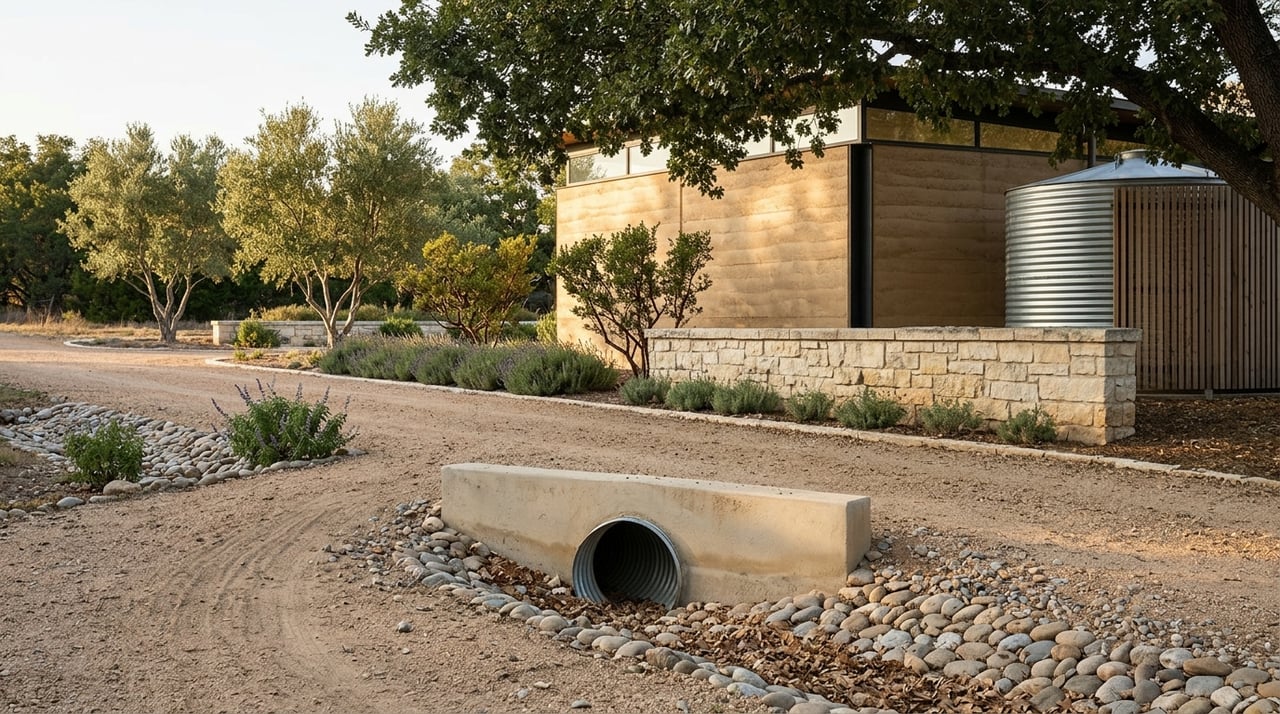
Legal and physical access can have a major effect on cost and timing. A parcel may appear straightforward on a map, yet still require additional review if a new driveway, culvert, or road upgrade is needed.
Start by confirming whether access is by public road or recorded easement. You want to know not only that access exists, but also how it is documented and whether improvements may be required to make the parcel usable.
Napa County regulates encroachments over, upon, or under county road rights-of-way through its road standards and Title 12. If your project requires a driveway connection to a public roadway, the permittee is responsible for that connection, for maintaining drainage facilities, and for preserving sight distance.
That can make access a bigger engineering and permitting question than buyers expect. Before committing, ask whether the county may require an encroachment permit or a road-related exception.
Topography is part of the appeal of Napa country land, but it can also introduce real limits. If a project disturbs one acre or more, Napa County says it needs State Water Resources Control Board construction stormwater coverage.
The county also restricts grading and earthmoving in stream setback areas. Its baseline materials note that erosion-control plans are generally required for grading or earthmoving on slopes greater than 5 percent unless an exemption applies.
If the parcel is steep, rocky, or close to sensitive drainage areas, the site may need more than a simple buildability review. Grading, erosion control, and stormwater compliance can all shape what is feasible and how long approvals may take.
This is one of the clearest examples of why land value is tied to usable potential, not just acreage. Two parcels of similar size can have very different outcomes once site conditions are fully understood.
When you are evaluating Napa country land, the order of your questions matters. A practical sequence can save time, reduce surprises, and keep you from spending money on the wrong studies too early.
Napa County points buyers toward GIS resources, Planning, Building and Environmental Services, Environmental Health, and Roads as key entry points. A strong process usually starts broad, then gets more site-specific.
This sequence helps you test the parcel against your actual goals. It also helps you avoid assuming that a beautiful piece of land will automatically support the use you have in mind.
For septic feasibility, Napa County defines a qualified professional as a licensed civil engineer, geologist, registered environmental health specialist, or soil scientist. Depending on the parcel, those voices can be essential.
For agricultural or vineyard land, the county’s groundwater workplan points buyers to Napa County RCD irrigation evaluations, UC Cooperative Extension, and NRCS as practical resources. The right team can help you understand whether the parcel can truly support its intended use, not just whether it can close escrow.
The most important question is not whether you can buy the parcel. It is whether the parcel can support what you want to do with it.
In Napa County, that means looking past the views and into the fundamentals: zoning, preserve status, water supply, wastewater capacity, access, and site conditions. When you do that work upfront, you give yourself a much better chance of buying with confidence.
If you are considering Napa country land and want experienced, property-specific guidance, Jeff Earl Warren can help you evaluate the details that matter before you commit.
Stay up to date on the latest real estate trends.



How to Handle Contingencies in Your Oakville Real Estate Process.

Where to Brunch in Yountville to Slow Down Your Day.

Questions on Real Estate We Hear Regularly in Yountville.
Home Improvements to Consider Before You List in Oakville.

Get assistance in determining current property value, crafting a competitive offer, writing and negotiating a contract, and much more. Contact us today.